Most damage and most customs friction in a furniture order happen after the invoice is agreed, in the last 48 hours before the container is sealed. Packing and loading are also where buyers have the least visibility, because they are usually not in Foshan when it happens. This checklist covers what to specify in the quotation, what to photograph, and what to sign off before the doors close.
What export packing actually covers
Export packing is not one carton decision. For furniture it is four decisions that have to agree with each other:
- Inner protection — foam or wrap on exposed surfaces, corner guards on frames, protection between stacked units.
- Outer packaging — export carton or crate, taped and labelled per model.
- Loading pattern — what goes on the floor, what stacks on top, where bracing goes.
- Documents — packing list, invoice and labels that describe exactly what is inside.
Buyers usually ask only about the outer carton. In practice the loading pattern is the expensive one: a heavy dining table stacked over sofa frames, or a pallet pushed hard against the door end, causes more claims than a thin carton ever will.
Packing by product type
Upholstery
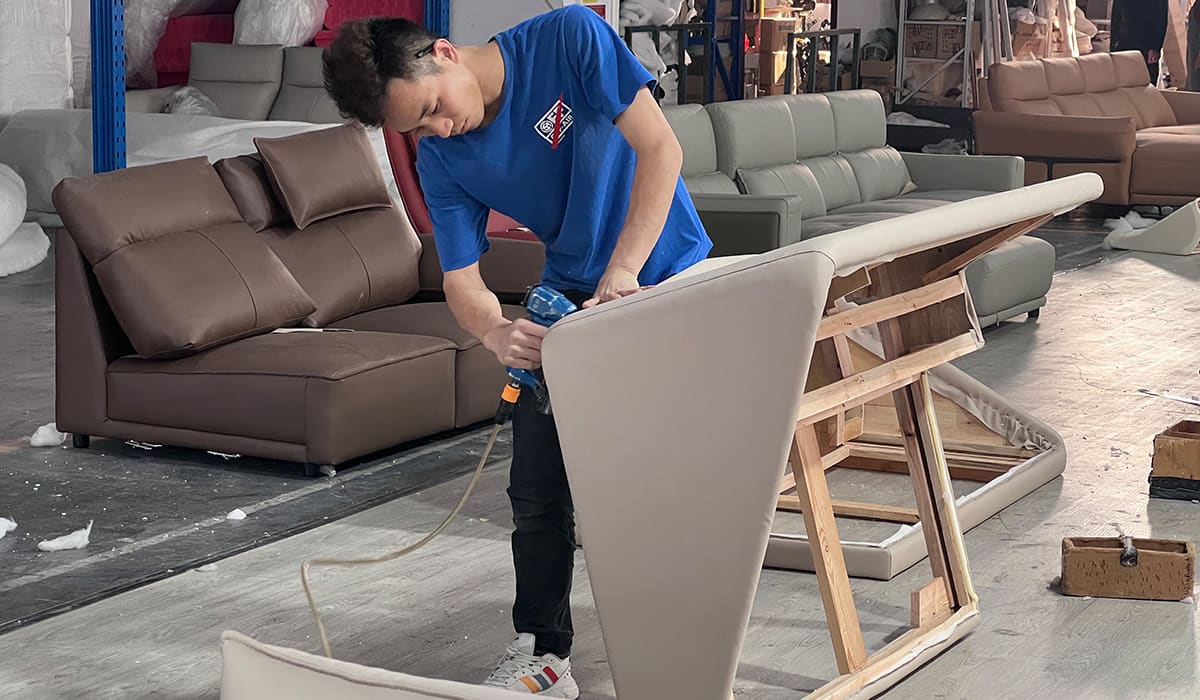
Sofas and beds are volumetric, so they are packed to protect edges and faces rather than to save cube. Ask for corner protection on frames and arms, and for a wrap that does not trap moisture against leather. A modular piece such as the HD2443 modular leather sofa ships as several units, which is an advantage: modules stack flatter and are easier to brace than one large frame.
Case goods
Dining tables, coffee tables and sideboards are the opposite problem — heavy and hard. Flat-pack or knock-down construction reduces cube, but every joint becomes a stress point in transit. Check that table tops travel vertically rather than flat, and that legs are boxed separately. A round top like the T26-D001 dining table is a good test case: ask how the top is edge-protected and how the base is prevented from sliding into it.
Beds and mattresses
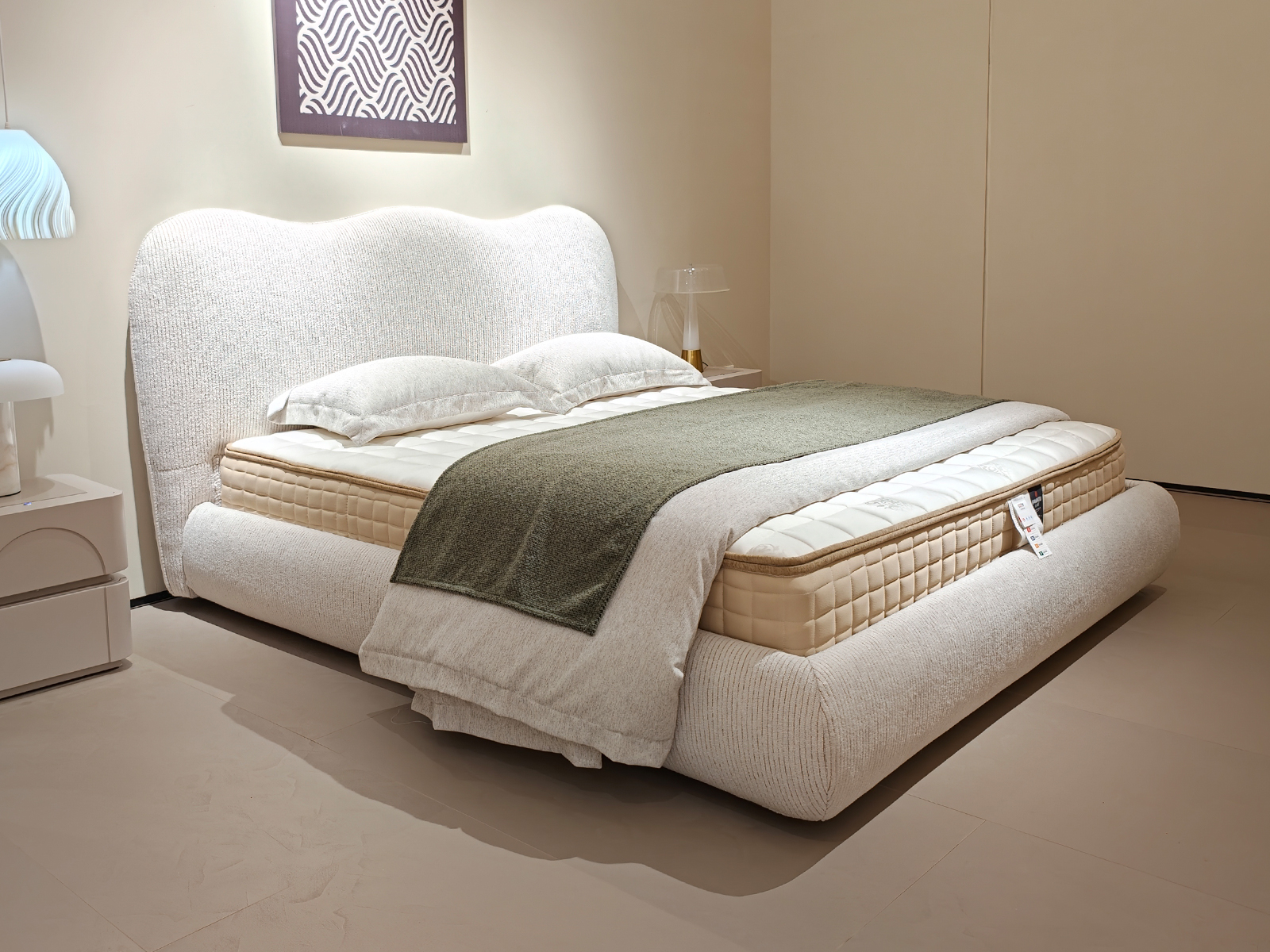
Upholstered beds follow the upholstery rules; mattresses depend on whether they ship flat or roll-packed, which changes both cube and how the rest of the container is planned. We cover that trade-off separately in roll-pack vs flat-ship mattresses. A bed frame such as the A6058 is usually the heaviest single item in a mixed load, so it should be planned first, not last.
Building a mixed 40HQ loading plan
A first order rarely fills a container with one category, and it does not need to. Standard models carry no MOQ and mix freely with beds, dining or mattresses in a single 40HQ; custom pieces start from 5 pieces per design. What matters is that the loading quantity is confirmed model by model on the quotation, so the plan is built from real dimensions instead of an estimate.
Three rules make a mixed load work:
- Heaviest first. Beds, dining bases and case goods go on the floor toward the front and middle; upholstery fills the upper space.
- Leave room for bracing. A container that is 100% full has nowhere to put the bars and airbags that stop movement. Plan for gap, not zero gap.
- Keep the door end light. The door end flexes most in transit. Soft goods and light cartons belong there.
Photos and video you should receive before the container is sealed
Ask for this in writing when you place the order, not after. A workable set is:
- A short video inspection of each production batch before packing, showing seams, foam density and finish.
- Photos of the packed cartons with labels visible, before loading starts.
- Photos of the loading in progress: stack pattern, corner protection, bracing.
- Photos of the closed container with the seal number readable, plus the seal number in the email body.
These four sets answer almost every damage dispute, because they show the condition at the moment the container left the factory rather than a week later at destination.
12-point pre-shipment checklist
| # | Check | What to look for |
|---|
| 1 | Carton labels | Model code, quantity and destination match the packing list |
| 2 | Corner protection | Guards on all frame corners, not only the visible ones |
| 3 | Surface protection | Wrap on leather and lacquer, without trapping moisture |
| 4 | Stack pattern | No heavy item over an unsupported upholstered frame |
| 5 | Bracing | Bars or airbags at the door end and along gaps |
| 6 | Loading sequence | Heaviest at the front and floor, light goods at the door |
| 7 | Quantity count | Recount against the packing list before sealing |
| 8 | Sample reference | Production matches the signed sample, not the catalogue photo |
| 9 | Hardware and parts | Fittings, legs and tools boxed and labelled per unit |
| 10 | Wood packaging marks | IPPC/ISPM 15 stamp on any solid-wood crate or pallet |
| 11 | Documents | Invoice, packing list and HS codes consistent with the load |
| 12 | Seal record | Seal number photographed and sent with the loading photos |
Five failure modes that cost the most
- Corner crush from stacking. Upholstered frames carry weight they were not designed for. Guards plus a stack limit fix it.
- Moisture in the humid season. Guangdong summers are unforgiving. Ask what desiccant or barrier is used and whether cartons are lined — a question worth asking before production, not after arrival.
- Label and packing-list mismatch. The fastest way to turn a clean shipment into a customs delay. Recount at sealing, not at destination.
- Over-loading with no bracing space. A few extra units are not worth a collapsed door end.
- Unrecorded substitutions. If a model or fabric changes, it has to be agreed in writing and reflected in the loading photos.
Documents that travel with the container
At minimum: commercial invoice, packing list, and HS codes that match the goods. Wooden packaging needs the ISPM 15 mark. If you buy on DDP terms, the freight, duty and last-mile documents are handled by the forwarder, but the packing list still has to be right, because that is the document customs opens first. Export customs paperwork is part of the quotation here, so the document set is prepared alongside the loading plan rather than after it.
How packing and loading are handled at ATTICO CASA
Production runs in our 20,000 m² factory in Jiujiang, Nanhai, with the 5,000 m² showroom in Lecong used for range review and sample approval. Inspection is a 25-point in-line and pre-shipment check, with third-party lab testing against the signed sample when a market requires it, a video report for every batch before packing, and container loading photos sent with the seal number. Export cartons use corner protection, and DDP delivery can be arranged to your warehouse.
If you want to see the packing and loading process rather than read about it, the factory and showroom are open daily 09:00–18:00, with a about 40 minutes from the Lecong furniture district — plan a factory visit. Full commercial terms, including MOQ and lead times, are on the wholesale page, and the complete model range is in the product catalogues.
FAQ
How many pieces fit in a 40HQ container?
It depends on the mix. Loading quantity is confirmed model by model on the quotation, so the figure you receive matches the models you actually order rather than a generic estimate.
Can I mix sofas, beds and dining in one container?
Yes. Standard models carry no MOQ and mix freely with beds, dining or mattresses in a single 40HQ. Custom orders start from 5 pieces per design.
Do you provide container loading photos?
Yes. Loading photos are sent with the seal number, together with a video inspection report for every batch before packing.
Who carries out the quality inspection?
We run a 25-point in-line and pre-shipment inspection internally, and third-party lab testing against the signed sample can be arranged when your market requires certification.
What are the lead times?
30–45 days for standard models and 45–60 days for custom and OEM/ODM orders, counted from deposit and specification confirmation.



Leave a Comment