佛山软体家具制造 | 20 年(始于 2006)

如何从佛山采购商业餐桌椅——完整指南

Home - Blog - 采购与供应链
Reading Time: 11 min  ( Word Count: 2520 )

Short answer: Foshan's commercial dining furniture cluster supplies 70% of the world's contract-grade restaurant tables and chairs — but the difference between a program that lasts five years and one that fails after twelve months is decided in three places: the material specification, the fire and durability standards, and the factory that actually owns the production line.

This guide is written from the production floor at ATTICO CASA in Foshan's Longjiang cluster — the same protocol we hand to restaurant owners, hotel procurement teams, and commercial developers before they sign a contract furniture purchase order.

Every month, thousands of sets of dining tables, chairs, booths and bar stools leave Foshan for restaurants, hotels, cafés, banquet halls and pubs across North America, Europe, the Middle East, Australia and Southeast Asia. The wholesale dining furniture category follows the same supply-chain economics as sofas — vertically integrated within a 30-minute radius — but the buyer profile and the failure modes are different. Sofa buyers care about comfort and warranty. Commercial dining buyers care about fire compliance, wear resistance, and whether the furniture will pass the safety inspection that keeps their venue open.

Why Foshan for Commercial Dining Furniture

Foshan holds 70% of the world's commercial dining furniture volume for three structural reasons. First, the cluster is vertically integrated within a 30-minute drive: solid-wood milling shops, sintered-stone and quartz fabricators, metal stamping, powder-coating lines, foam suppliers and upholstery workshops all share the same industrial zone. Second, the cluster has learned the hard way what commercial-grade means. Furniture for a restaurant banquet hall that seats 120 people per night has different wear requirements than furniture for a residential dining room, and Foshan's factories have spent twenty years meeting those requirements for buyers on four continents. Third, the cluster can mix categories. A single Foshan factory can quote dining tables, chairs, booths, bar stools and outdoor patio furniture in one program — which matters for hotel and restaurant FF&E buyers who need one factory contract instead of six.
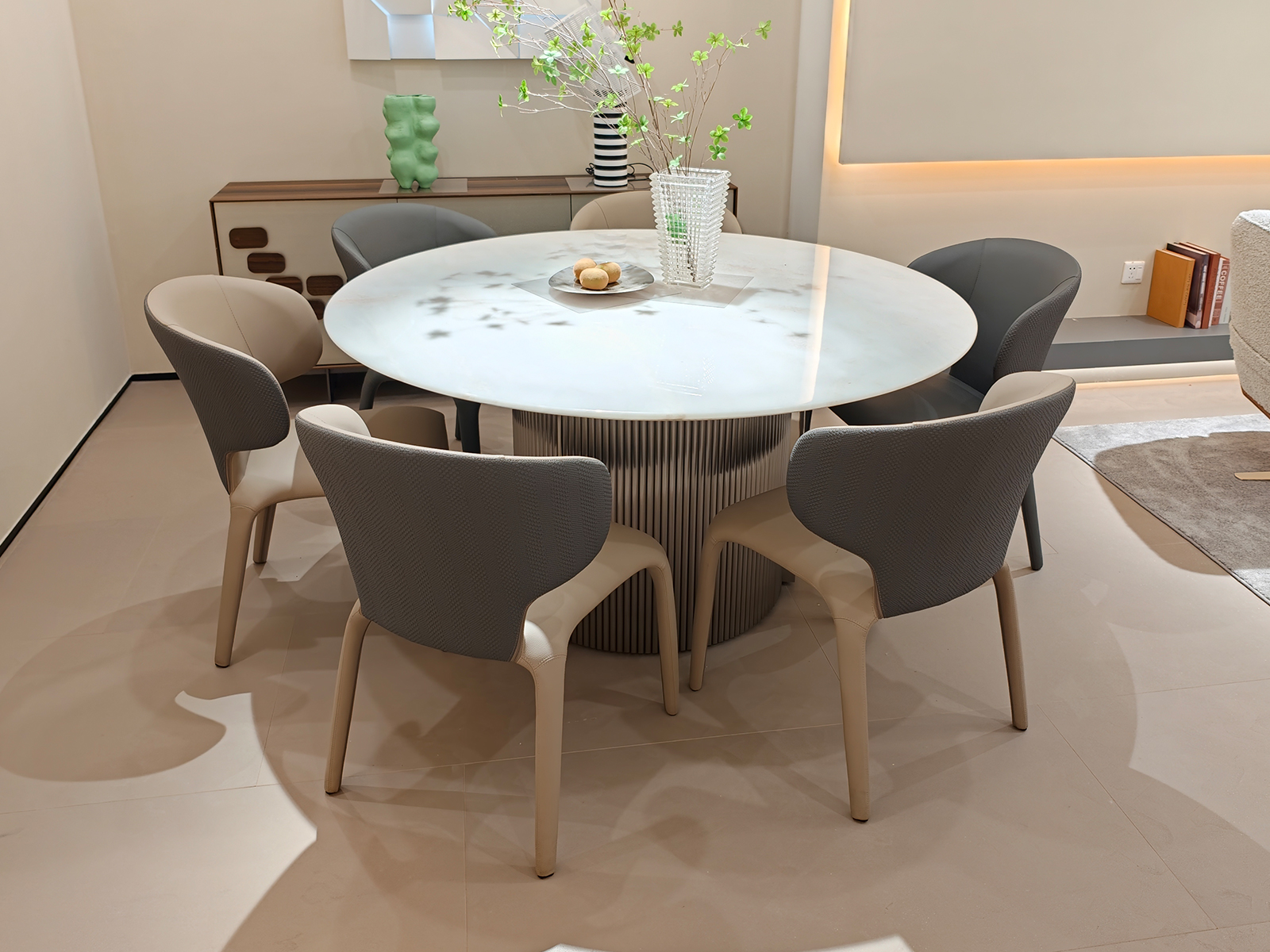
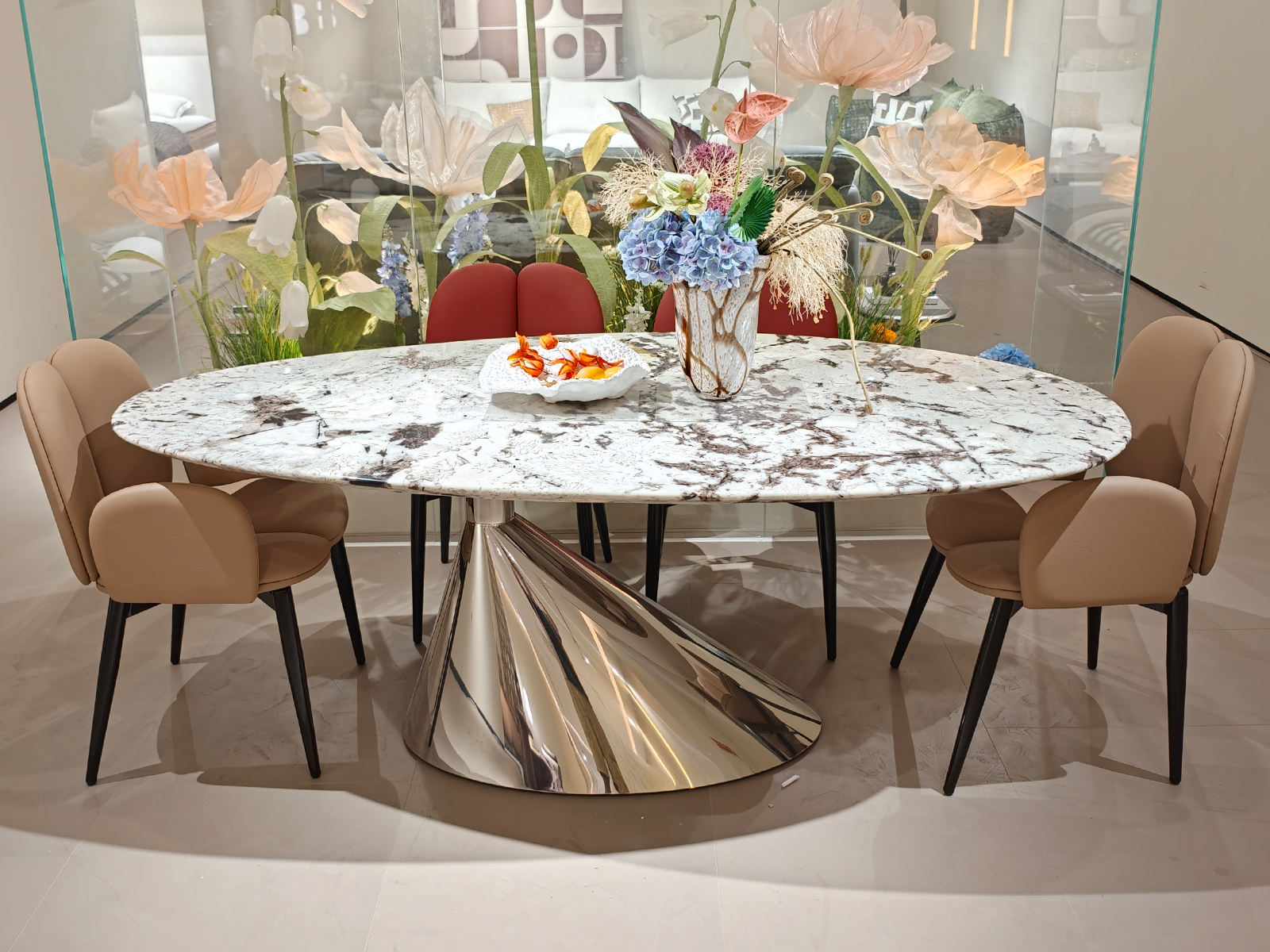
Commercial dining table set in ATTICO CASA Foshan factory showroom
Commercial dining table and chair set for restaurant programs — solid beech frame, sintered-stone top, 25,000+ Martindale rub count upholstery

Types of Dining Furniture Foshan Supplies

The category breaks into six program types, each with its own MOQ, pricing and buyer profile.

  • Restaurant dining sets: Tables and chairs for full-service restaurants — the largest volume segment. Tables range from 4-seat squares to 10-seat banquet rounds; chairs run from stacking metal frames to fully upholstered side chairs.
  • Booth and banquette seating: Upholstered banquettes and booths for casual dining and chain restaurants. Customizable in length, cushion density and fabric grade. Fire compliance is mandatory.
  • Café and coffee shop furniture: Smaller-scale programs with higher design sensitivity. Often mixed with accent armchairs and small coffee tables. Lower MOQ at a slight per-unit premium.
  • Bar stools and counters: Stools in metal, wood or upholstery, and bar counters in solid wood, sintered stone or stainless steel. Height-standardized at 75 cm (bar) or 65 cm (counter) for export.
  • Banquet and event furniture: Folding tables, stacking chairs and portable bar counters for event centers and hotel ballrooms. Load-bearing capacity is the critical specification — not comfort.
  • Outdoor patio dining: Aluminum frames with powder-coat finish, weather-resistant fabric and synthetic wicker. UV-stabilized materials are non-negotiable for export to Australia, Dubai and Southern Europe.

Commercial Grade vs Residential: The Actual Differences

The gap between residential and commercial dining furniture is not aesthetic — a commercial chair can look identical to a premium residential chair. The difference is in the specification sheet, and it drives the price difference between the two. Commercial-grade requirements:

  • BIFMA X5.1 or EN 16139 load capacity: Residential chairs are tested at 150 kg static load. Commercial chairs are tested at 250 kg static load and 100,000 seat cycles. A commercial chair that passes EN 16139 will outlive its residential equivalent by 3–4x in a high-traffic venue.
  • Fire retardant upholstery and foam: BS 5852 (UK), CAL 117 (California), NFPA 260 (US commercial contract) and EN 1021 (EU). Without a third-party fire test report, a restaurant owner cannot legally install upholstered furniture in their venue — and they know it. Residential furniture almost never specifies fire retardant grades.
  • Martindale rub count: Commercial upholstery is specified at 25,000–40,000 Martindale rubs. Residential is typically 15,000–20,000. Above 40,000 rubs, the fabric cost jumps sharply, and the marginal benefit flattens — 30,000 rubs is the sweet spot for most restaurant programs.
  • Frame reinforcement: Commercial dining chair frames add corner gussets, stress-relieved welds and thicker gauge steel (1.8 mm minimum vs 1.2 mm residential). Solid wood frames are kiln-dried to 8–10% moisture content and corner-blocked on every joint.

Dining Table Materials: What Matters for Commercial Use

Five surface materials dominate the commercial dining category, each with a different maintenance profile, price point and wear life.
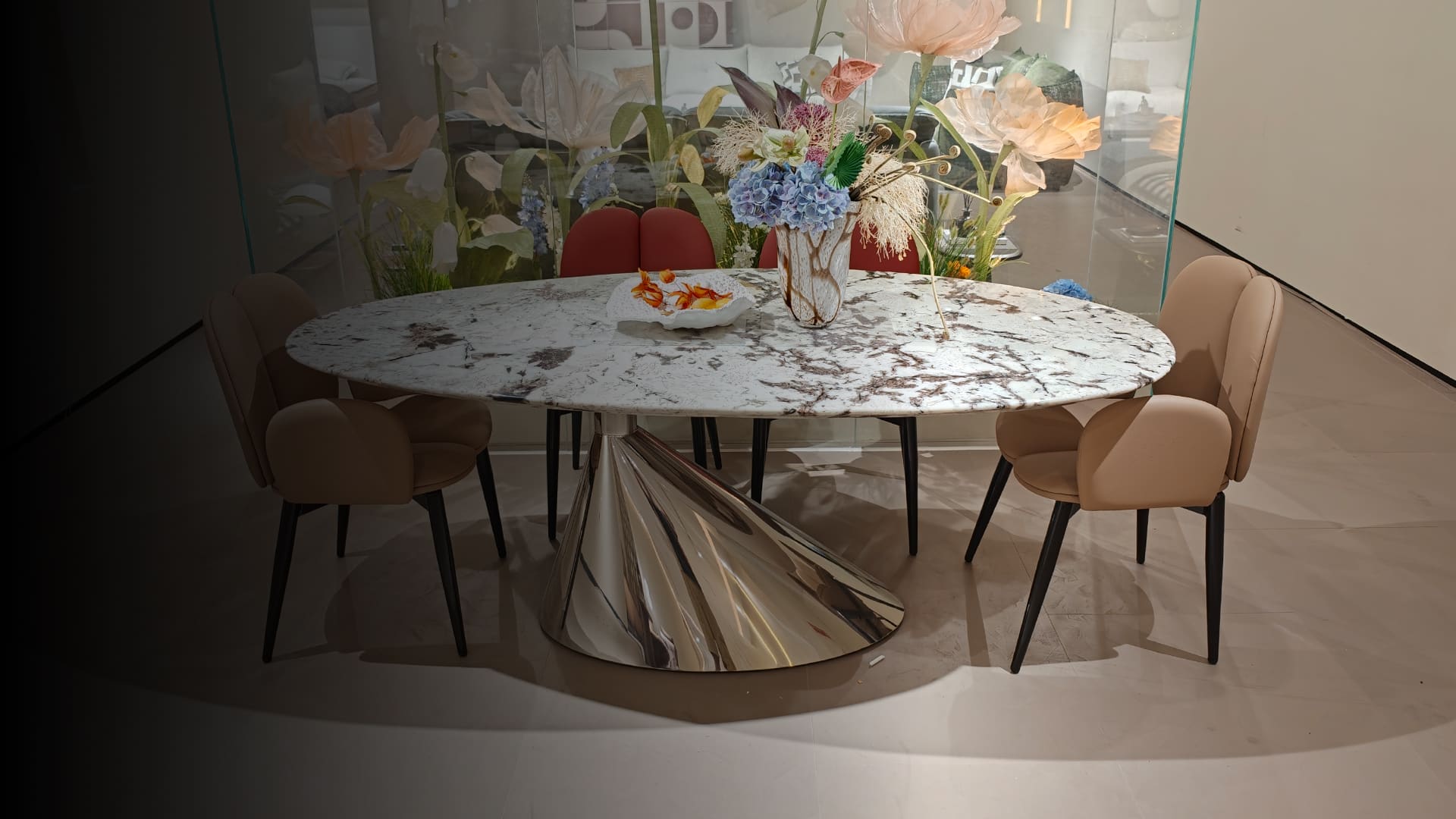
  • Sintered stone: The fastest-growing commercial material. 12 mm sintered stone tops resist heat (up to 300°C), scratches, stains and acids. Maintenance is wiping with a damp cloth. Wholesale pricing is $80–$180 per table top depending on size. The only commercial material that does not require annual resealing or waxing.
  • Solid wood: Kiln-dried beech, oak, ash or walnut. Needs annual resealing with polyurethane or natural oil. Scratches and dents are repairable — which matters for restaurants that want to keep tables looking new. Wholesale pricing is $95–$220 per table top.
  • HPL (high-pressure laminate): Budget commercial option. 12 mm HPL with a solid wood edge band. Heat-resistant to 180°C, scratch-resistant but not scratch-proof, and cannot be repaired. Wholesale pricing is $45–$100 per table top.
  • Glass: Tempered glass at 10–12 mm for commercial use. Always paired with a frame (never glass-only for commercial dining). Easy to clean but shows every fingerprint. Wholesale pricing is $60–$140 per table top.
  • Metal (steel, stainless steel, aluminum): Powder-coated or brushed steel tops for industrial-chic venues. Heat and scratch resistant, but cold to touch in winter. Wholesale pricing is $55–$120 per table top.
Sintered stone dining table top at ATTICO CASA material sample showroom
Material sample wall showing sintered stone, HPL, solid wood and metal table tops for commercial programs

Dining Chair Styles and Materials

Commercial dining chairs fall into five structural types, each with a specific use case and price range.

  • Wood-framed side chair: Solid beech or ash frame with upholstered or wooden seat. The workhorse of casual dining. EN 16139 load-tested, corner-blocked joints, and a 20+ year wear life in a 3-seats-per-day restaurant.
  • Metal stacking chair: Powder-coated steel frame, polypropylene or wooden seat. The default for banquet halls and event venues — folds or stacks for storage, 200 kg static load, 50,000 seat cycle test. Wholesale pricing is the lowest in the category.
  • Upholstered armchair: Fully upholstered with a solid wood or steel frame, high-resilience foam and fire-retardant fabric. Used in premium restaurants and hotel dining rooms. CAL 117 or BS 5852 fire compliance is a must.
  • Sled-base chair: Steel frame with a single curved base that slides smoothly across restaurant floors. No legs to wobble, no floor protectors to replace. The premium option for fine dining.
  • Bar stool: Height options at 65 cm (counter) or 75 cm (bar). Available in wood, metal or fully upholstered. SGS-tested gas lifts on adjustable-height models.

Fire and Safety Standards That Are Non-Negotiable

Commercial dining furniture buyers who cut corners on fire compliance do not lose money — they lose their business. A restaurant that fails a fire inspection in the EU or US is closed until the furniture is replaced, and the cost of replacing a full dining room set overnight is 3–5x the cost of building compliant furniture into the original program. The four standards you will specify:

  • BS 5852: UK upholstered furniture flammability standard. Cigarette ignition (Source 1) and match ignition (Source 5) tests. Mandatory for any upholstered chair or booth installed in a UK commercial venue.
  • CAL 117 Section 1 (formerly TB 117-2013): California upholstered furniture flammability. Open-flame test on the foam core. California's de facto national standard for the US contract market — virtually every major North American restaurant brand specifies it.
  • NFPA 260 Class A/B/C: US contract furniture flammability. Class A is the highest, required for high-occupancy venues (auditoriums, banquet halls, hotel ballrooms). Class B for standard restaurants. Class C for low-occupancy.
  • EN 1021 Part 1/Part 2: EU upholstered furniture. Cigarette test (Part 1) and match test (Part 2). Mandatory for any upholstered furniture sold in the EU since 1995.

At ATTICO CASA we do not hold fire test certificates on every model — we build to the test standard and arrange third-party testing through SGS, BV or TÜV for your specific program. The cost is $300–$1,200 per model, and the report is yours. See our certifications page for what we hold and what we arrange.

MOQ, Lead Time and Wholesale Pricing

The Foshan commercial dining furniture standard is 50 pieces per model, with mixed container loading across models and product types. Pricing varies by material and standard tier.

ProductCommercial Grade TierWholesale Price (EXW Foshan)
4-seat sintered-stone dining tableStandard (BIFMA X5.1, 25k rubs)$180–$280
4-seat sintered-stone dining tablePremium (EN 16139, BS 5852, 35k rubs)$290–$420
Wood-framed side chair (upholstered)Standard (BIFMA, 25k rubs)$65–$95
Metal stacking chairCommercial (200 kg, 50k cycles)$28–$45
Banquette booth (2-seat)Premium (CAL 117, 30k rubs)$220–$340
Bar stool (upholstered)Commercial (SGS gas lift)$55–$85

Production lead time is 45–60 days after deposit and specification confirmation. Freight adds 20–40 days to North America or Europe depending on port. Payment terms: 30/40/30 (deposit / production completion with photo proof / pre-shipment inspection pass before loading). EXW, FOB, CIF and DDP all supported.

Packaging and Container Loading for Commercial Programs

Commercial dining furniture packs two ways, and the choice is driven by destination and product type. KD (knock-down) packing ships chairs and tables flat-packed in corrugated boxes with assembly hardware and instruction sheets. A standard 40HQ holds 120–150 KD dining chair sets with tables, vs 60–80 fully assembled. Foshan commercial programs are nearly always KD because the freight savings are significant. For high-end custom pieces or glass-top tables, standard pre-assembled packing with corner protectors and foam wrap is the safer choice despite the lower load count.

Mixed-container loading is the norm. A single 40HQ can carry restaurant dining sets, café side chairs and bar stools in the same shipment — which is what hotel FF&E buyers do when fitting a new build. Tell us your product list and we send you the cube calculation before you commit.
KD packed commercial dining chairs ready for container loading at Foshan factory
KD-packed wood-framed dining chairs stacked and palletized for export container loading

Quality Inspection for Commercial Furniture

Commercial dining programs are high-volume and high-visibility — a restaurant cannot open with mismatched chairs or tables that wobble. The inspection protocol at ATTICO CASA has three layers:

  • Milestone photos during production: Frame assembly (before upholstery) and finish application (before packing). You see the production, not just the end product.
  • Third-party pre-shipment inspection: SGS, BV or TÜV pulls random pieces from the production line and tests load capacity, fire compliance and finish quality against your specification report. Cost $300–$600 per inspection.
  • Post-shipment warranty: 2-year commercial warranty on frame structure and welding, 1-year on finish and upholstery. Defective pieces are replaced FOB free.

Importantly: commercial furniture buyers should not skip the third-party inspection. Residential programs can sometimes get away with a factory's self-inspection. Commercial programs cannot — the liability exposure is too high.

Common Commercial Furniture Buying Mistakes

Seven patterns we see repeat in nearly every failed commercial dining program:

  • Specifying residential grades to save money: A residential-grade chair in a 300-seat restaurant fails in 12–18 months. The replacement cost is 3–5x the premium you would have paid for commercial grade.
  • Not requesting fire test reports up front: Some factories quote commercial prices and supply residential upholstery. Request the test report number before you place the order, not after you receive the goods.
  • Confusing "heavy-duty" with "commercial-grade": "Heavy-duty" is a marketing term. "EN 16139" or "BIFMA X5.1" is a tested standard. Specify the standard, not the adjective.
  • Forgetting the frame material specification: Two chairs with identical upholstery can have different frame lives — one with 1.8 mm stress-relieved steel and corner gussets, another with 1.2 mm plain steel. Specify the frame gauge and reinforcement.
  • Assuming "all-weather" means commercial-grade outdoor: Residential outdoor furniture is UV-rated for 2–3 years. Commercial outdoor needs 5-year UV-stabilized powder coat and marine-grade hardware.
  • Mixing veneer and solid wood without knowing: Veneer looks like solid wood but cannot be refinished. If you expect to refinish tables in year three, specify solid beech or oak, not veneered MDF.
  • Ordering all chairs in one batch without holding a sample: Run a 10-piece sample program first — test them in your actual venue for two weeks, check they stack properly, and confirm maintenance is what you expected.

FAQ

What is the difference between commercial-grade and residential dining furniture?

Commercial-grade furniture is tested to higher load capacities (200–250 kg static vs 150 kg residential), more seat cycles (50,000–100,000 vs 10,000), higher Martindale rub counts (25,000–40,000 vs 15,000), and mandatory fire compliance (BS 5852, CAL 117, NFPA 260, EN 1021). The gap is not visual — a commercial chair can look identical to a premium residential chair — and it drives a 3–5x longer wear life in high-traffic venues.

Which fire standard should I specify for my market?

BS 5852 for UK venues, CAL 117 Section 1 (formerly TB 117-2013) for North American commercial programs, NFPA 260 Class A or B for high-occupancy US venues, and EN 1021 Part 1/Part 2 for the EU. Fire compliance laws vary by region — some countries require local third-party testing before import. We can arrange testing through SGS, BV or TÜV for your program.

What is the MOQ for commercial dining furniture?

The Foshan commercial standard is 50 pieces per model, with mixed-container loading across models and product types. A 40HQ can carry 120–150 KD dining chair-and-table sets. Trial programs under MOQ are possible at a 10–15% premium for venue testing.

Can I customize the materials and colors for my brand?

Yes. Table top materials (sintered stone, solid wood, HPL, glass, metal), chair upholstery fabrics (30+ fire-compliant options), frame finishes (matte black, brushed gold, natural wood) and custom logo embroidery are all available. Fully custom programs run through our OEM/ODM service.

How long does production take, and what are your payment terms?

Production is 45–60 days after deposit and specification confirmation. Ocean freight adds 20–40 days depending on destination port. Payment: 30% deposit / 40% at production completion (with photo proof) / 30% after pre-shipment inspection passes before loading.

Do you arrange container loading and shipping?

Yes, EXW, FOB, CIF and DDP terms are all supported. KD packing optimizes container space: 120–150 KD dining sets per 40HQ vs 60–80 fully assembled. We build the loading plan around your product mix and send you the cube calculation before you commit.

Source commercial dining furniture directly from our Foshan factory

20+ years manufacturing · BIFMA / EN 16139 / CAL 117 / BS 5852 compliant · MOQ from 50 pcs per model · EXW/FOB/CIF/DDP worldwide.

Address: No. 4, Jianye 2nd Road, Shatou Nanjin Village Industrial Zone, Jiujiang Town, Nanhai District, Foshan City, Guangdong Province, China
WhatsApp / WeChat: +86 150 1742 8790
Email: [email protected]

View Dining Collection Request Contract Quote
Neo Lee

Neo Lee

Export Director, ATTICO CASA

Neo Lee leads export sales at ATTICO CASA's Foshan factory, working directly with B2B importers, retailers, and hospitality buyers on product specs, sampling, compliance, and shipping. He writes from the production floor in Shunde.

Leave a Comment

ATTICO CASA

请求报价

  • 工厂直供价(无中间商)
  • DDP 全球物流(门到门)
  • OEM/ODM 定制设计支持
  • 严格 ISO 9001 质量控制
ISO 9001:2015 FSC Mix 巅峰奖 高新技术企业
请验证您是真人 成功!
未选择文件